Life Size Statue of Japanese Artist With Raindrops at Minneapolis Institute of Art
 | |
 | |
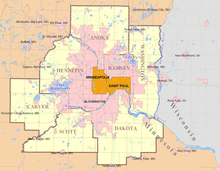
| Location inside Minneapolis–Saint Paul | |
| Established | 1883 (1883) |
|---|---|
| Location | 2400 Tertiary Avenue South Minneapolis, Minnesota |
| Coordinates | 44°57′31″N 93°xvi′27″Westward / 44.95861°Northward 93.27417°W / 44.95861; -93.27417 Coordinates: 44°57′31″North 93°16′27″West / 44.95861°Northward 93.27417°W / 44.95861; -93.27417 |
| Collection size | 90,000+ |
| Visitors | 760,000 (2016) |
| Director | Katherine Luber |
| Public transit admission | metrotransit Motorcoach: 11B, 11C, 17, xviii |
| Website | artsmia.org |

The Minneapolis Institute of Art (Mia) is an arts museum located in Minneapolis, Minnesota, United states of america. Home to more than 90,000 works of art representing v,000 years of world history, Mia is one of the largest art museums in the United States. Its permanent collection includes world-famous works that embody the highest levels of artistic achievement, spanning about xx,000 years and representing the globe'south diverse cultures across six continents. The museum has 7 curatorial areas: Arts of Africa & the Americas; Contemporary Art; Decorative Arts, Textiles & Sculpture; Asian Art; Paintings; Photography and New Media; and Prints and Drawings.
Mia is one of the largest arts educators in Minnesota. More than a half-1000000 people visit the museum each year, and a hundred thousand more are reached through the museum'due south Art Gamble program for elementary schoolchildren. The museum'due south free general admission policy, public programs, classes for children and adults, and honour-winning interactive media programs have helped to broaden and deepen this museum's roots in the communities it serves.[1]
History [edit]

The Minneapolis Society of Fine Arts was established in 1883 to bring the arts into the life of the community. This group, made up of business and professional leaders, organized art exhibits throughout the decade. In 1889, the Society, now known equally the Minneapolis Institute of Art, moved into its first permanent space, within the newly congenital Minneapolis Public Library.
The institute received gifts from Clinton Morrison and William Hood Dunwoody, among others, for its building fund. In 1911, Morrison donated the state, formerly occupied past his family's Villa Rosa mansion, in memory of his male parent, Dorilus Morrison, contingent on the plant's raising the $500,000 needed for the building. A few days later the establish received a letter of the alphabet from Dunwoody, who got the ball rolling: "Put me downwards for $100,000." A fundraising dinner a few days later brought in $335,500, donated in xc minutes.[three]
The new museum, designed by the house of McKim, Mead and White, opened in 1915. The building came to be recognized as one of the finest examples of the Beaux-Arts architectural style in Minnesota. The fine art historian Bevis Hillier organized the exhibition Fine art Deco at the museum, presented from July to September 1971, which acquired a resurgence of interest in this style of fine art. The edifice was originally meant to be the outset of several sections, just simply the front slice built. Several additions have been congenital to other plans, including a 1974 addition by Kenzo Tange. An expansion designed by the 2012 Driehaus Prize winner Michael Graves was completed in June 2006. Earlier the latest expansion, but 4 per centum of the museum's virtually 100,000 objects could exist on view at the same time; at present that figure is 5 percent.[4] [5] Target Corporation, for which the new wing is named, was the biggest donor, with a pb gift of more than $10 million.[four]
In 2015 the institute rebranded itself, dropping the final "southward" from its name, to get the Minneapolis Institute of Fine art and encouraging the employ of the nickname Mia instead of the acronym MIA.[6] [vii]
Kaywin Feldman became director and president of the institute in 2008. During her tenure, omnipresence doubled, digital admission was emphasized, and social justice and equity programs were adopted. In Dec 2018, she was named to be the next director of the National Gallery of Fine art took that role in March 2019.[8] [9]
In October 2019, Katherine Luber, formerly of the San Antonio Museum of Fine art, was named equally the new managing director and president of Mia.[10]
Drove [edit]
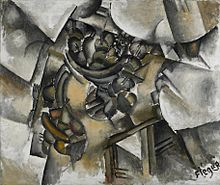
Fernand Léger, 1910–11, Le compotier (Table and Fruit), oil on sheet, 82.two x 97.viii cm

Henri Matisse, 1907, Les trois baigneuses (Three Bathers), oil on canvas, 60.three x 73 cm

Joan Miró, 1920, Les cartes espagnoles (The Spanish Playing Cards), oil on canvas, 63.5 x 69.5 cm
The museum features an encyclopedic collection of approximately eighty,000 objects[11] spanning 5,000 years of world history. Its collection includes paintings, photographs, prints & drawings, textiles, architecture, and decorative arts. At that place are collections of African art, art from Oceania and the Americas, and an especially strong collection of Asian art, called "one of the finest and most comprehensive Asian fine art collections in the land".[12] The Asian collection includes Chinese compages, jades,[13] bronzes, and ceramics.[12]
The institute owns the Purcell-Cutts House, just e of Lake of the Isles. The house was designed by Purcell & Elmslie and is a masterpiece of Prairie School architecture. Information technology was donated to the museum by Anson B. Cutts Jr., the son of its second owner. The firm is available for tours on the 2nd weekend of each calendar month.[14] [fifteen]
Services [edit]
In order to encourage individual collecting and assist in the acquisition of important works of art, the museum has created "analogousness groups" aligned with the 7 curatorial areas of the museum. The groups schedule lectures, symposia, and travel for members.
The museum features a regular series of exhibitions that bring in traveling collections from other museums for display. Local business organization partners fund many of these exhibitions, and some characteristic the artists leading public tours through the exhibition.
The museum houses the Minnesota Artists Exhibition Program, an artist-controlled program devoted to the exhibition of works by artists who live in Minnesota.[xvi]
The Museum Library contains more than sixty,000 volumes on art and art history. The library is open to the public.[17]
Selected objects [edit]



Outdoor exhibits [edit]
The institute has a number of exhibits outside the building.[18] A pair of Chinese lions sit on either side of the 24th Street entrance. They were a gift from Ella Pillsbury Crosby in 1998. Because a museum curator determined that it would exist besides difficult to export 18th-century statues, new ones were carved in People's republic of china in the 18th century fashion.[19]
The bronze statue The Fighter of the Spirit, by Ernst Barlach stands near the 24th Street entrance. The statue shows a winged man holding a sword vertically, tip upwards, and standing on the back of a snarling beast. The statue was commissioned by the Academy of Kiel and was originally placed in front of its church (Holy Spirit Church). The statue did not fit with the ideals of the ruling National Socialist political party; information technology was vandalized and condemned as degenerate art. As a result, the statue was removed and cut into four pieces, in preparation for melting downwardly. Nevertheless, the pieces were hidden on a subcontract and didn't resurface until 1946. The statue was repaired and placed in front of the Church of St. Nicholas (the Holy Spirit Church having been destroyed during the state of war).[20] [21] Two copies of the statue were made at this fourth dimension; the MIA acquired one copy in 1959; the other is in forepart of the Gethsemane Church building in Berlin.[22] [23]
The Chinese Garden, which can be seen from inside the café, contains Taihu stones. These stones are said to correspond the mountains of the Buddhist and Taoist immortals.[18] The garden was a souvenir of Ruth and Bruce Dayton.[24]
Target Park, which sits behind the museum, contains several gimmicky statues, including an untitled piece of work in bronze (c. 1968) by Pietro Consagra, Samba in African granite (1993) by Richard Erdman, and L'arbre de vie in stainless steel and pigment (20th century), designed by Jean Willy Mestach and manufactured by Michael Chowen.[25] In that location is besides a granite and steel pavilion entitled Labyrinth (1993) by John Willenbecher. In that location are broad lines cut into the steel roof of the pavilion so that when the viewer stands within, the labyrinth can exist viewed by looking up.[xviii] [26]
To celebrate its 100th ceremony, the institute purchased a sculpture past the Polish creative person Igor Mitoraj (1944–2014). Eros Bendato Screpolato, 1999, is 1 of a series of bronze "bandaged heads" produced by Mitoraj. Similar Mitoraj sculptures can exist found at other public sites, including Marketplace Foursquare in Kraków, Poland, and Citygarden in downtown St. Louis, Missouri.[27] [28] [29]
Management [edit]
Finances [edit]
The William Hood Dunwoody Fund, endowed with one million dollars when Dunwoody died in 1914, has been used to purchase thousands of works.[thirty] Bruce Dayton, a life trustee of the institute since 1942, insisted that money raised in the $100 meg fund-raising campaign for the Target wing, which opened in 2006, be separate evenly between the building and the acquisitions endowment. That fund, now at $91 million, has immune the institute to purchase a rare early on 18th-century Native American painted buckskin shirt and a nine-foot-long topographical View of Venice fabricated by Jacopo de' Barbari in 1500, among other contempo purchases.[31] In 2009, the value of the museum's $145 meg endowment had fallen 21 percentage from Jan 2008. The endowment typically provides nearly ane-5th of operating revenues. Contributions from individuals, corporations and foundations business relationship for a quarter of revenues,[32] Virtually half of the museum's operating money comes from the "park-museum fund," a century-old Hennepin County tax dating to 1911 that provides public support in exchange for free admission. That fund, which has risen steadily in contempo years, provided the museum $12.vi one thousand thousand in the financial year of 2010. In 2011, the museum's annual budget was at $24.6 million, and endowment income was a total $4.iii million.[33]
In August 2016, the institute appear a $6 million bequest to fund the Gale Asian Fine art Initiative, which is designed to highlight the museum'south holdings in Asian art, estimated at 16,800 objects. The bequest was fabricated past Alfred P. Gale, an heir to the Pillsbury flour fortune. The first exhibition of the initiative volition be Ink Unbound: Paintings by Liu Dan. Liu Dan, a contemporary Chinese creative person has been asked to create an ink painting based on a painting in the museum'due south collection. Dan chose St. Paul and St. Barnabas at Lystra, a 17th-century painting past the Dutch artist Willem de Poorter.[34]
Notes [edit]
- ^ "Minneapolis Constitute of Art". New.artsmia.org . Retrieved August xviii, 2016.
- ^ "Rembrandt'due south Lucretias". National Gallery of Fine art via Internet Archive. Archived from the original on November 17, 2004. Retrieved November 13, 2016.
{{cite web}}: CS1 maint: unfit URL (link) - ^ Gihring, Tim (January 1, 2015). "Mia Stories". Minneapolis Institute of Fine art. Retrieved August xviii, 2015.
- ^ a b Tillotson, Kristin (June 9, 2006). "Minneapolis Found of Arts Opens New Fly". Star Tribune. Archived from the original on April three, 2015. Retrieved August xviii, 2016.
- ^ Wurzer, Cathy (June 7, 2006). "Minneapolis Institute of Arts Opens New Wing". Mprnews.org . Retrieved August eighteen, 2016.
- ^ "MIA reboots brand to become 'Mia'". Mprnews.org. Baronial 10, 2015. Retrieved August 18, 2016.
- ^ Tim Gihring (August 3, 2015). "Once at Mia: What'southward in a proper name? — Minneapolis Institute of Art". New.artsmia.org . Retrieved August 18, 2016.
- ^ Kerr, Euan, "Mia'southward managing director volition leave to head National Gallery", Minnesota Public Radio News, December eleven, 2018.
- ^ McGlone, Peggy, "The National Gallery of Art will accept a female director for the get-go time in its history", The Washington Mail, December 11, 2018.
- ^ Sheets, Hilarie M. (1 October 2019). "A New Leader for the Minneapolis Establish of Art". The New York Times . Retrieved 2 October 2019.
- ^ "William M. Griswold Appointed New Director of the Minneapolis Establish of Arts". Retrieved 10 April 2017.
- ^ a b "New and Improved: The Minneapolis Institute of Arts Reopens". Antiques and the Arts Online. Archived from the original on 2007-09-27. Retrieved 2007-09-04 .
- ^ Amidst these is a 1784 piece believed to exist the largest historic jade sculpture outside of People's republic of china. "Jade Mountain Illustrating the Gathering of Poets at the Lan T'ing Pavilion". Art de fifty'Asie. www.framemuseums.org. Archived from the original on 2007-10-07. Retrieved 2007-09-04 .
- ^ "Purcell–Cutts House". Collections.artsmia.org . Retrieved August 18, 2016.
- ^ "Unified Vision: The Architecture and Design of the Prairie School > The Purcell-Cutts Bout". Archive.artsmia.org . Retrieved August 18, 2016.
- ^ "The Minnesota Artists Exhibition Program (MAEP)". artsmia.org . Retrieved August xviii, 2016.
- ^ "Museum Library". Minneapolis Institute of Art. Retrieved February 5, 2018.
Located on the commencement flooring of the Michael Graves-designed Target wing, the Art Enquiry and Reference Library Reading Room is gratis and open to the public.
- ^ a b c Mault, Coco (October 24, 2011). "A Look at MIA'southward Outdoor Art". Minnesota.cbslocal.com . Retrieved August eighteen, 2016.
- ^ Gehrz, Jim; Abbe, Mary (December 29, 2012). "Ella Pillsbury Crosby: Museum Lioness". Startribune.com . Retrieved August 18, 2016.
- ^ Paret, Peter; Helga Thieme (thirty Apr 2012). Myth and Modernity: Barlach's Drawings on the Nibelungen. Berghahn Books. pp. 45–47. ISBN978-0-85745-346-4.
- ^ "Erinnerungstag 19. Juni 1954: Geistkämpfer von Ernst Barlach vor der Nikolaikirche enthüllt". kiel.de (in German). Archived from the original on August 21, 2016. Retrieved August 19, 2016.
- ^ "The Fighter of the Spirit, Ernst Barlach". Collections.artsmia.org . Retrieved August nineteen, 2016.
- ^ "Gethsemanekirche: Prenzlauer Berg". Berlin1.de (in German). Archived from the original on August 20, 2016. Retrieved August 19, 2016.
- ^ "Chinese Rock Garden, China". Collections.artsmia.org . Retrieved August xviii, 2016.
- ^ "Y'all searched for target park — Minneapolis Institute of Art". New.artsmia.org . Retrieved Baronial 18, 2016.
- ^ "Labyrinth, John Willenbecher". Collections.artsmia.org . Retrieved August eighteen, 2016.
- ^ "Eros Bendato". inyourpocket.com . Retrieved Baronial xviii, 2016.
- ^ Uren, Adam (April 28, 2015). "The Big, Bronze Head Worth $1M: Meet Minneapolis Museum's Newest Attraction". Bringmethenews.com . Retrieved August 18, 2016.
- ^ "Gateway Foundation". Gateway-foundation.org . Retrieved August 18, 2016.
- ^ "This fund tin can only be used for the purchase of works of art." Arts, Minneapolis Institute of (1922). Handbook of the Minneapolis Constitute of Arts. p. eight. Retrieved August sixteen, 2015.
- ^ Dobrzynski, Judith H. (March 14, 2012). "A Fund for Buying Art Burnishes Collections and Reputations". New York Times . Retrieved August xviii, 2016.
- ^ Abbe, Mary (March 5, 2009). "MIA Cuts Staff, Programming". Startribune.com . Retrieved August xviii, 2016.
- ^ Abbe, Mary (April 20, 2011). "Minneapolis Found of Arts Cuts Jobs to Salvage Budget". Startribune.com . Retrieved August 18, 2016.
- ^ Abbe, Mary (August 18, 2016). "Minneapolis Institute of Art Gets $6 Meg for "Gale Asian Art Initiative"". Startribune.com . Retrieved Baronial eighteen, 2016.
External links [edit]
- Official website
- Minneapolis Found of Art site at Google Arts & Civilization
Source: https://en.wikipedia.org/wiki/Minneapolis_Institute_of_Art
0 Response to "Life Size Statue of Japanese Artist With Raindrops at Minneapolis Institute of Art"
Enregistrer un commentaire