Middle School Language Arts Lesson Plans for Station Teaching
Grammar stations are perfect for secondary students. Yous can rotate and address confusion and successes, and your students get to movement and learn from others. If you're looking for center school English language grammar activities, try stations.
Younger students use stations as a normal part of their schoolhouse day. Older students savor them too! I utilize stations in many capacities, but I overwhelmingly motility my students through grammar stations. My hope for this weblog mail service is to outline ways you tin exist successful for designing grammar stations.
So many teachers ask me near ELA grammar and making it meaningful. When I treat ELA grammar like I do other parts of form, I find success. Just every bit I would make literature or writing stations, I use grammar stations. I've successfully used stations with loftier school students, but I often used learning stations for middle school ELA.
What works with language arts station piece of work? Honestly, near projects and activities volition work equally station work equally long as you provide structure. You don't need a fancy download or complex directions for making station piece of work suitable for your students. Program ahead. Generally, my station work:
- Has 6 to seven stations. I don't programme on every student hitting every station. The more complex stations? I have groups that simply won't motion to them.
- Spreads around the room and hall. I generally ask my coworkers if they listen if students are in the hall. Unremarkably, no one cares. Exceptions might include examination days or guest speakers where hall movement should exist minimized.
- Works based on time. I tell students they have 6 minutes (I suit if necessary) for each station, and I time them.
- Has a student answer canvass fabricated up of a Google Document that they can share with me. If students do easily-on manipulation pieces, they take a picture and insert it in the document.
Basically, don't complicate grammar stations. These should exist fun and should allow students to experiment with their language.
Middle school English grammar lessons tin can be meaningful with purposeful activities. If y'all've never done grammer stations, you might wonder why I love them. Sure, learning stations for middle school ELA are interactive and fun, merely grammar? stations? Why do I utilize grammar stations? Permit me count the ways. . .

Secondary students enjoy them.
My older students enjoy those class periods far above any other days. Because my students are older than younger kiddos, you might need to adjust how you handle situations. For instance, I spread out students so they don't interfere with other groups. I put some groups in the hall during non-busy times. I also encourage student option inside the stations.
Before I begin stations, I provide procedures. I item the timing system (often four-7 minutes per station, dependent on the class length and number of stations), all students must participate, and what I expect them to submit at the end of the twenty-four hour period.
Plus, once you have a system for creating stations, y'all'll find what certain classes enjoy and learn the most from. If a grade dislikes 1 way of practicing, I simply remove that action from future rotations.
Students move.
Then much of schoolhouse is sitting, and when students movement and physically participate in an activity, they remember the material more. I constantly search for means to make grammer meaningful, and stations support that movement that is so crucial for kinesthetic learners. Learning stations for middle schoolhouse English grammar encourage motion.
Every bit I move among students, they ask questions. Students are more comfy asking questions with simply one or ii other students with them. I get honest questions when students are moving and the unabridged class is not staring at them.
Teachers tin provide flexibility.
For the size of my room, I typically brand 8 stations where students sit and work. If students will stay at a station for a short period and move quickly throughout the hour, I'll organize fifteen stations. I don't always blueprint the same stations, and I don't grade all of the work. Often, I'll enquire students to plow in or have a picture of their all-time assignment.
The best part? Many activities tin hands get station piece of work. With a bit of modifications, y'all can add interactive activities for all levels of learners. In fact, you can take a "challenge station" where students attempt an advanced grammar concept. You can also tell students they may skip one station.
Flexibility and student pick are the keys to successful grammar stations.
Now, download this costless grammar station organizer. You can add together specific directions for what your students need on those pages. When I explicate directions that I add together below, I am sharing with y'all what I put on those grammer station dividers. Organize your ELA grammar stations with that free download.
Then, decide what will work for your students with the amount of fourth dimension you have. So, arrange the material for your students and determine what procedures will ensure success.
Beneath, you tin see possibilities for grammer stations. Keep in mind that I encourage educatee pick, scaffolded do, and opportunities (high and depression) for everyone. Meanwhile, I circulate and gather important data about what students understand. I receive valuable insight into where my lessons should go next.
I run across myself every bit a director as students rotate. I once feared chaos, simply now I tell myself that learning is messy. I also don't fright asking students to repeat a station or to skip a station. As I observe and take notes (on learning levels, potential pitfalls, ideas for future lessons), I intervene with actress questions to increase circuitous thinking or rephrase ideas to help students grasp concepts. As the managing director of grammer stations, yous volition quickly learn what your students need from you.
Using the station dividers, determine what stations you need. Add directions that will help your students. Make yourself notes, and get your materials prepare.
And! Here are fifteen possible grammer stations:
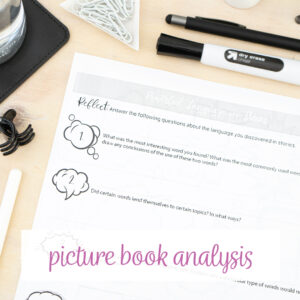
Station One: moving-picture show books.
Grab a basket of picture books and print one-pagers for students to find verbs, adjectives, and adverbs. Picture books utilize dynamite words which makes them perfect for finding grammatical concepts. The 1-pagers don't demand to be one per group, either. For case, ask groups to find 5 verbs for the one-pager, and then students volition have a collaborative finished production.
A note: exist sure to exist selective in what flick books you provide. Students might not benefit from "how-to" books, for example, when looking for strong words.

Station Two: writing.
Stack some notation cards or sticky notes at this grammar station. Then, ask students to practice the grammer concept in their writing. For case, ask every grouping to write one elementary judgement, one compound, one complex, and one compound-complex. You lot tin can use the gluey notes equally additions to anchor charts. Use the note cards as exit tickets another day.
Equally a fun twist, you lot can provide directions such equally, write 2 sentences with four power verbs on a piece of paper. Then, the next group must keep the story the showtime group started. (The stories are typically hilarious.) This group action is the perfect way to practice punctuating dialogue.
Be sure to share the finished story with the grade.
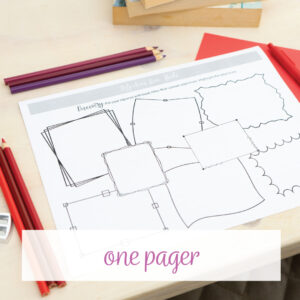
Station Three: young developed literature title search.
Stack piles of young adult literature and print out a ane-pager for students to detect adjectives. Then, ask students to create new titles using their adjectives.
Teachers have turned this into book spine creations and writing assignments. After students think of a new young adult title, ask them to write the first page of their new book. (You can keep their one-pagers and inquire them to practise the writing another mean solar day.)
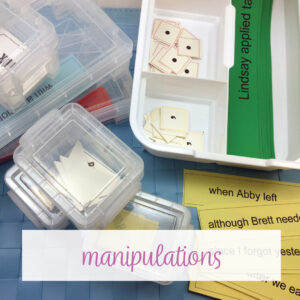
Station Iv: sentence structure manipulations.
Hands-on grammer might be the all-time grammar station! In my grammar manipulative bundle, I provide directions, merely you can make your own directions besides. Use grammer pieces to build sentences to focus on sentence construction.
You can also scaffold the lesson back and practice coordinating conjunctions, correlative conjunctions, and conjunctive adverbs. With easily-on grammar, all students can be successful.
This station is often easily-off for me. The simply directions I include are for students to take pictures for me. This allows me to afterward see if I need to address misunderstandings. Most oftentimes though, I get together the pictures in a basic Google presentation and use information technology to practice with students.
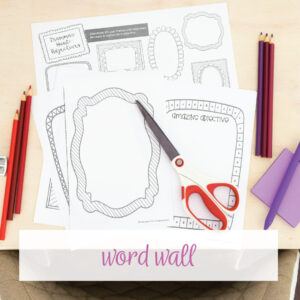
Station V: build a discussion wall.
Any vocabulary you are studying, ask students to sort between adverbs, adjectives, and nouns to create an interactive give-and-take wall. Students can practise their lexical category with pictures, group writing, or private sentences.
I typically impress out our current vocabulary study for this station and ask students to complete two frames for our give-and-take wall. And so, I assemble the discussion wall and apply it to review vocabulary. This practice makes for a nice integration of grammer to other parts of class.
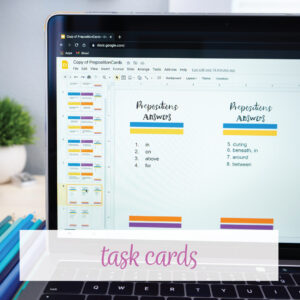
Station Six: task cards.
Chore cards were made for station work! I frequently ask students pass task cards amongst each other and forget how nicely they work with stations. Job cards already have directions, and I only include directions on the station dividers for how many task cards to complete.
Task cards do let me to differentiate equally well. You can gear up up different boxes of task cards and permit students choose which ones they can handle. (I love that sort of data.)

Station Seven: action verbs.
Brainstorming and talking through activity verbs is a fantastic way to connect grammar to vocabulary and then to student writing.
I typically pull verbs that are very common (too mutual!) in student writing. So, I ask students to make a listing or an anchor chart for new ways to give-and-take the mutual phrases. For instance, I'll inquire students to retrieve of new activity verbs for, "the writer SAYS" or "the writer WROTE." This grammar station directly connects to student writing and builds community.
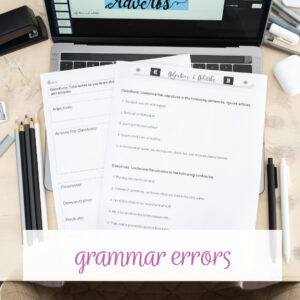
Station Eight: common grammar errors.
Grammar is SO much more finding errors, but sometimes student writing shows us that we need to address grammer concerns. If you have troublesome areas, pattern a grammar station that addresses common errors.
Like and then many of the other stations, the review of grammer errors is the perfect opportunity to reinforce that grammer is connected to other parts of class.
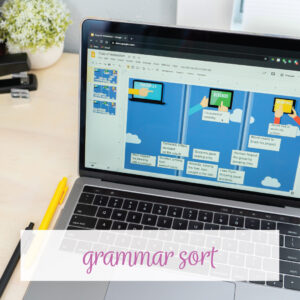
Station Nine: grammar sort.
Grammar sorts are just grammar concepts in action on pieces of paper that students sort. For case, students can sort active from passive voice, simple sentences from compound sentences, or verb moods. You can make these sorts a group effort and have students glue the pieces for a form poster, or you tin have students sort them, snap a moving-picture show, and pile the pieces again, set for the next group to sort.
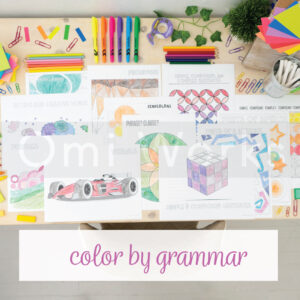
Station Ten: color by grammar.
A color by grammar station typically has directions (I type the directions on the gratis dividers) for students to consummate iii or four coloring options. At the finish of the class period, we have finished grammar sheets for decorations.
Coloring relaxes students, and this is frequently a favorite station.
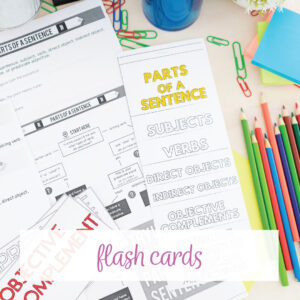
Station Eleven: flash cards.
The flash card station is another station that is easy to differentiate, and non every educatee volition complete this station. (You tin can also employ a flash card station as part of any learning stations for middle schoolhouse ELA.)
If students need basic review, enquire them to create wink cards with definitions. If students are past that, ask them to think of rules. (I am flexible on the directions I provide for this station. Sometimes, I simply straight students to brand grammer flash cards for what they know. I gather that data and build lessons from there.)
Nonetheless, if yous want every pupil to complete every station, think of avant-garde tasks. Inquire students to write a comma dominion and think of an example. For instance, using commas in a series is a basic task, simply using commas with coordinate adjectives is a more advanced task.
Then, the right (I go through the flash cards!) flash cards become property of the class, and doing then honestly builds classroom community. Students will practice those wink cards, or I will set them out as we piece of work on other projects. The creators always want recognition of their flash cards and will talk to their peers nigh using them.

Station Twelve: mentor sentences.
I print several curt stories or nonfiction pieces nosotros have covered as a class. To connect grammer to literature and articles, I highlight important sentences. Then, I ask questions on the station dividers. Students choose their sentences that I've highlighted and respond questions such equally:
- What is the upshot of passive voice?
- Did you lot notice a verb mood switch? What does that point?
- How did judgement structure provide transitions?
- Where did you see a "broken" grammar rule? Did you like that the author took this run a risk? Why?
Mentor sentences are typically a hard grammer station, and some students might not piece of work through it. I accept asked students to repeat this station (in one case with fiction and once with nonfiction) while some students stay at a lower tiered station.

Station 13: digital do.
A digital activity works best if you lot are a ane:one school, but you could maybe take this arranged on a classroom computer. Students consummate an overall review in a Google Quiz. I like using these with grammer stations considering I get a break with this station, as the results are automatically recorded. Plus, students get firsthand feedback which they like.
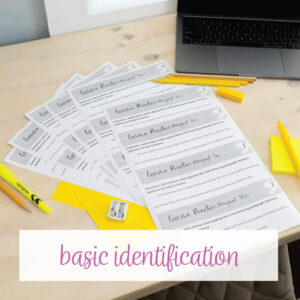
Station Fourteen: bones identification.
Basic identification may be one of the scaffolded ends of grammer stations, and non anybody will travel to this station. I don't label this station as the first station and then assign students that showtime station considering the scaffolding volition be incredibly obvious. When students struggle with a concept, I will ask them to practice with me at this station. For example, students frequently struggle with comma apply. A quick review with a helpful list can end confusion.
If students tin can identify grammar concepts, I move students to an analytical or application type grammar station.

Station Xv: video.
Videos can become several ways, but they are e'er interesting.
- Inquire students to find a video to share with the class. (Students will probably find the conjunction song or a preposition trip the light fantastic.) Use those videos to recap the station work at the commencement of the next class period.
- If y'all are a i:1 school, allow students to brand a short clip of their caption of a concept. You can assign concepts with a bulleted listing on your grammar station dividers. Commonly, I picket videos of my students acting out action verbs. Students have also pretended to be commas in sentences.
Grammar stations are versatile and easy to scaffold and differentiate. With a bit of creativity apropos directions, most grammar activities tin work in a station rotation.
The benefits are huge! I tin can ask students to consummate modest sections and estimate where they are in their understanding. I can allow students to choose what they feel comfy studying, which in plow provides me with important information. Most importantly, students enjoy grammer stations. They handle their linguistic communication, they wait at grammar in versatile ways, and they openly talk to me. The class periods with grammar stations are some of the all-time days in my classroom.
I imagine y'all're reading this mail because you enjoy stations with older students! Melissa at Reading and Writing Haven has more ideas for yous. Cheque out Melissa'due south approach to learning stations.
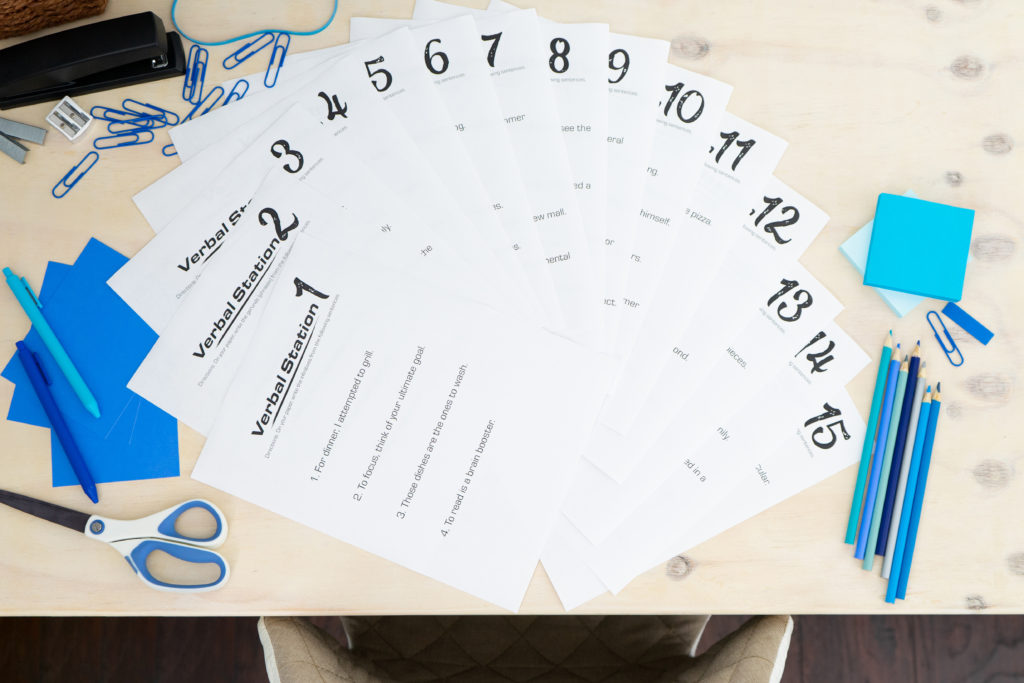
Are you interested in more grammar stations and learning stations for middle school ELA? Join Grammer Gurus for back up and ideas.
Source: https://languageartsclassroom.com/2020/02/grammar-stations-15-engaging-stations.html
0 Response to "Middle School Language Arts Lesson Plans for Station Teaching"
Enregistrer un commentaire